
Article · Volume 19, Issue 1 · pp. 274–281
Phytochemical Profiling and Inhibitory Impact of Piper nigrum and Syzygium aromaticum Extracts Targeting GH13 Family Amylases
Syeda Tayyaba Asif1, Mohtasheem Ul Hassan1, Shah Ali Ul Qader2, Madiha Jamshed1
- 1Department of Pharmacognosy, University of Karachi, Karachi, PAKISTAN.
- 2Department of Biochemistry, University of Karachi, Karachi, PAKISTAN.
Abstract
Background: Inhibition α-amylase have been reportedly providing a novel way in diabetes and obesity management.
Purpose: Research for the last decade has outlined on broad range of health beneficial of various condiments and it is evident that regular spicy food consumption in appropriate quantity is also the reason of reducing risk of death from chronic disorders.
Materials and Methods: The preliminary phytochemical screening methanol extracts of P. nigrum fruits and S. aromaticum flower buds were done for evaluation of phytochemicals. Therefore, the purpose of the present study is to find out the α-amylase inhibitory potential of commonly available spices named Piper nigrum (P. nigrum) and Syzygium aromaticum (S. aromaticum) at different parameters such as pH, temperature, time interval and days, which was carried out by using 3’5’-Dinitrosalicylic acid reagent (DNS) method. Statistical analysis was done by two-way ANOVA. For this purpose, phosphate buffer solution of P. nigrum and S. aromaticum were used.
Results: Phytochemical screening showed the presence of alkaloids, carbohydrates, flavonoids, glycosides, phenol, phytosterols, tannins and terpenes. P. nigrum most significant α-amylase inhibition showed at 7 pH (98.0±0.0%), 37ºC temperature (95.3±3.1%), day 6 (95.34±1.15) and at 15 min (83.3±3.1%), while S. aromaticum exerted stronger α-amylase inhibition at 7 pH (100.0±0.0%), at 37ºC temperature (96.7±1.2%) and 3rd day (97.34±1.15) and at 15 min (96.7±2.3%).
Conclusion: The present study provides the direct evidence that P. nigrum and S. aromaticum extract have great inhibitory potential of α-amylase enzyme so; by using these ideal parameters it will be useful in diabetes and obesity management.
Keywords: α-amylase; DNS (3’5’-Dinitrosalicylic acid reagent); P. nigrum (Piper nigrum); S. aromaticum (Syzygium aromaticum)
FULL TEXT
INTRODUCTION
Diabetes is a metabolic disorder characterized by abnormal function of metabolic system which results high blood sugar level. Diabetes is a rapidly growing international health issue of 21st century due to frequent use of gadgets, less physical activity as well as increase consumption of sugary drinks and oily foods. Children have also frequently developed diabetes and approximately 6% of the world population is affected, which is a warning indication for researchers and health care sector (Khan et al., 2020).
In diabetes, alpha amylase is responsible for carbohydrate breakdown into simple sugar which then absorbed through wall of small intestine into the blood stream which directly influence in blood sugar level. Inactivation of amylase enzymes contributes to postpartum hyperglycemia in diabetic patients. Therapeutically available antidiabetic medicines exert their medicinal effect through various mechanisms such as elevation of insulin secretion, glucose absorption, and metabolism. Amylase is a principal enzyme which split complex sugar into glucose and maltose present in saliva and pancreatic juice (Whitcomb and Lowe, 2007). Alpha amylase is a dominant secretory product and has a fundamental role in starch and glycogen digestion and, it is a valuable enzyme commercially and industrially (Kandra et al., 2003).
In diabetes, carbohydrate digestion can be controlled through amylase inhibition, which is influenced by factors such as pH, time interval, and temperature. In diabetes, maximum inhibition of the amylase enzyme, which are assists in sugar breakdown ranges normally from 45 to 55ºC, which can be reduced by alteration in temperatures. The optimal pH range for amylase is 6.7-7.0. Deviations from these ranges, whether toward acidic or alkaline conditions, can affect the stability and function of both hydrolytic enzymes. Inhibition of amylase has a positive impact on duration or time-dependent regulation of blood sugar in diabetic patients, as delaying carbohydrate digestion helps reduce postprandial blood glucose levels, improve glycemic control, and potentially delay the onset of long-term diabetes-related complications (Ren et al., 2024; Sauer et al., 2000).
Various herbal extracts and their active compounds have been reported as hydrolytic enzyme inhibitors as their main antidiabetic action (Kumar et al., 2011). Piper nigrum L. named as “King of spices” because of its strong fragrance (Srinivasan, 2007). P. nigrum belongs to the family Piperaceae and is cultivated in subtropical areas all over the world (Lim, 2012). P. nigrum has a wide spectrum of health benefits including anti-platelet, antineoplastic, antispasmodic, anti-diarrheal, analgesic, hepato-protective and antimicrobial activity (Harman et al., 2021; Ahmad et al., 2012; Manoharan et al., 2009). Lowering sugar and cholesterol ability of Piper species in oil revealed its feasible process by inhibitory effect of hydrolytic enzyme (Murshida et al., 2024; Sulaimon et al., 2020; Kumar et al., 2013).Syzygium aromaticum L., commonly known as “clove”, is a member of Myrtaceae family, used to improve the flavor and aroma and used as preservative in variety of foods (Chaieb et al., 2007). S. aromaticum is habitat to the Maluku islands of Indonesia. The chemical constituents of S. aromaticum are pharmacologically used in many countries as antimicrobial, analgesic, carcino-protective and sedative (Abd et al., 2014; Khan et al., 2012). S. aromaticum contains significant amounts of phenolic compounds, which play an important role in diabetes by hydrolytic enzyme inhibition (Adefegha and Oboh, 2013; Neveu et al., 2010).
MATERIALS AND METHODS
Chemicals
All reagents and chemicals were of research grade chemicals and acquired by Sigma Aldrich, Merck. Di-nitrosalicylic acid for amylase assay was purchased from BDH laboratory supplies for alpha amylase assay.
Plant material extraction
Piper nigrum dried fruit and Syzygium aromaticum dried flower buds were purchased from the herbal market of Karachi, Pakistan. After being authenticated by Prof. Dr. Mohtasheem Ul Hassan, Department of Pharmacognosy, Faculty of Pharmacy and Pharmaceutical Sciences, University of Karachi, Karachi, Pakistan, P. nigrum dried fruits and S. aromaticum flower buds were cleaned by removal of extraneous particles and converted into powdered form by using a grinder. This powder was macerated in 200 mL phosphate buffer solution of neutral pH for three days at room temperature. Phosphate buffer is used instead of solvents because it maintains the optimal physiological pH required for activity and stability of enzyme. These 10% phosphate buffer extracts (0.1 gm/mL) were used in enzyme inhibitory assays at different parameters, including time interval, temperature, days, and pH. Performance was done in the research laboratory of the Department of Pharmacognosy and Department of Biochemistry, University of Karachi, Pakistan.
Methodology of phytochemical screening
Standard phytochemical screening methods used for identification of various phytochemicals from methanol extracts of Piper nigrum dried fruit and Syzygium aromaticum dried flower buds (Tanwieh et al., 2024).
Production of α-amylase
An α-amylase producing bacterial strain (Bacillus subtilis KIBGE-HAS) was obtained from the biochemistry department, University of Karachi. Medium composition followed by (Aslam et al., 2020; Triender, 1969) which contains yeast extract (1.0 g/dl), disodium phosphate (0.1 g/dl), peptone (1.0 g/dl), starch (1.5 g/dl), and calcium chloride (0.05 g/dl). 100 mL of medium of fermentation (pH 7.0) was distributed in 10 mL in inoculum tube and autoclaved (121ºC, 15 min). The inoculum tube analyzed by sterilized wire loop overfilled with bacterial strain was incubated (32ºC, 48 hr.). 10 mL inoculums were transferred to 90 mL fermentation medium and then incubated for 4 days (32ºC). Cells present in fermented media were isolated by centrifugation (10,000 rpm, 15 min, 4ºC) (Aslam et al., 2020; Trinder, 1969).
Αlpha amylase inhibitory assay at various parameters
The effect of P. nigrum and S. aromaticum extracts on the α-amylase enzyme was studied by using 3’5’-Dinitro salicylic acid (DNS) method with some modifications. For enzyme assay, potassium phosphate buffer (0.05 M) was used (pH 7.0). 3’5’-dinitrosalicylic acid was used as a reagent, and 1% starch was dissolved in potassium phosphate buffer was used as a substrate. 3’5’-Dinitro salicylic acid was used for the maltose examination (reducing sugar) in different concentrations (0.1, 0.2, 0.3, 0.4, 0.5, 0.6, 0.7, 0.8, 0.9, and 1.0), whereas maltose was utilized as a standard, maltose standard curve. Different parameters for alpha amylase inhibition were determined by measuring enzyme substrate reaction with extracts at different temperatures (27ºC, 37ºC), times (5, 15, 25, 30 min.), days (1, 3, 6, 9), and pH (5, 6, 7, 8, 9) and measuring their absorbance by UV spectrophotometer at 546 nm. For α-amylase, a standard maltose curve was prepared to estimate the maltose formation during the starch hydrolysis by α-amylase (Wang et al., 2022; Moein et al., 2017). Two-way ANOVA was used for statistical analysis. An amylase unit is mentioned as “The amount of enzyme that generates 1.0 µmol of maltose per minute from the starch hydrolysis as substrate in potassium phosphate buffer of pH 7.0.” One inhibitory unit of extract is established as 1 unit of inhibition activity of plant extract, defined as “The amount of inhibitor that decreases the enzyme activity of alpha amylase by 1 unit.”
The % inhibition of alpha amylase was calculated by using the following equation:
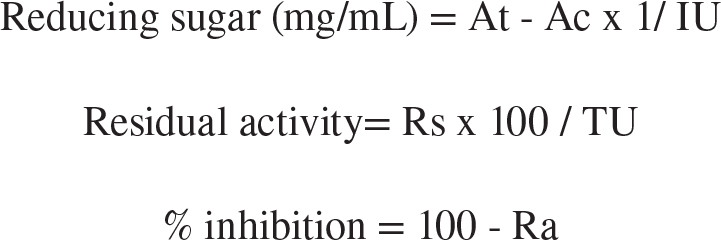
Where: At = absorbance of test, Ac = absorbance of control, IU = inhibitory unit, Rs = reducing sugar, Ra = residual activity, TU = test unit
Ethical statement
This article does not use any human participant or animal for amylase inhibitory assay.
RESULTS
Phytochemical screening
Phytochemical screening of P. nigrum and S. aromaticum extracts present in supplementary file, which showed the presence of alkaloids, carbohydrates, flavonoids, glycosides, phenols, phytosterols, tannins and terpenes.
α-Amylase
P. nigrum exhibited most significant α-amylase inhibition at 7 pH (98.0 ± 0.0%), 37ºC temperature (95.3 ± 3.1%), day 6 (95.34 ± 1.15) and at 15 min (83.3 ± 3.1%) whereas, S. aromaticum exerted stronger α-amylase inhibition at 7 pH (100.0 ± 0.0%), at 37ºC temperature (96.7 ± 1.2%) and 3rd day (97.34 ± 1.15) and at 15 min (96.7 ± 2.3%) (Figures 1-4 and Tables 1-4).
| Temp | Extract | N | Mean Inhibition | Standard Inhibition | Standard Error Inhibition | Mean % inhibition ± Standard (n=3) |
|---|---|---|---|---|---|---|
| 27 | PN | 3 | 87.34 | 7.57 | 4.372 | 87.34 ± 7.57 |
| 27 | SA | 3 | 96.01 | 2 | 1.155 | 96.01 ± 2.00 |
| 37 | PN | 3 | 95.34 | 3.1 | 1.764 | 95.34 ± 3.06 |
| 37 | SA | 3 | 96.68 | 1.15 | 0.667 | 96.68 ± 1.15 |
Data are mean ± SD (n=3), where PN = is P. nigrum and SA is S. aromaticum. The effect of temperature and extract type on α-amylase inhibition was analyzed by two-way ANOVA, with temperature (27 and 37ºC) and extracts (P. nigrum, S. aromaticum) as fixed factors. For each temperature-extract combination, the assay was performed in triplicate (n=3). Data are presented as mean ± SD. At 27 ºC, P. nigrum extract inhibited α-amylase activity by 87.3 ± 7.6%, whereasS. aromaticum showed 96.0 ± 2.0% inhibition (mean ± SD, n=3). At 37 ºC, the corresponding values were 95.3 ± 3.1% and 96.7 ± 1.2% for P. nigrum andS. aromaticum, respectively (Table -01). Two-way ANOVA revealed no statistically significant effects of temperature [p=0.115], extract type [p=0.076], or their interaction [p=0.173] on percentage inhibition. Although inhibition tended to be higher forS. aromaticum than for P. nigrum and at 37ºC compared with 27ºC, these differences did not reach statistical significance (p>0.05).
| Time | Extract | N | Mean Inhibition | Standard Inhibition | Standard Error Inhibition | Mean % inhibition ± Standard (n=3) |
|---|---|---|---|---|---|---|
| 5 | PN | 3 | 46.01 | 24 | 13.86 | 46.01 ± 24.00 |
| 5 | SA | 3 | 35.34 | 16.17 | 9.33 | 35.34 ± 16.17 |
| 15 | PN | 3 | 83.34 | 3.06 | 1.76 | 83.34 ± 3.06 |
| 15 | SA | 3 | 96.68 | 2.31 | 1.33 | 96.68 ± 2.31 |
| 25 | PN | 3 | 62.01 | 8 | 4.62 | 62.01 ± 8.00 |
| 25 | SA | 3 | 82.68 | 10.26 | 5.93 | 82.68 ± 10.26 |
| 35 | PN | 3 | 8.01 | 2 | 1.15 | 8.01 ± 2.00 |
| 35 | SA | 3 | 26.68 | 19.01 | 10.97 | 26.68 ± 19.01 |
For the timecourse assay, αamylase inhibition by P. nigrum and S. aromaticum extracts varied markedly with incubation time (Table 2). At 5 min, inhibition was 46.0 ± 24.0% for P. nigrum and 35.3 ± 16.2% for S. aromaticum (mean ± SD, n=3). It increased to 83.3 ± 3.1% and 96.7 ± 2.3% at 15 min and then declined by 35 min (8.0 ± 2.0% and 26.7 ± 19.0% for P. nigrum and S. aromaticum, respectively). Twoway ANOVA showed a highly significant effect of time on inhibition [p<0.001], whereas the main effect of extract and the time × extract interaction was not significant (p>0.05).
| pH | Extract | Mean Inhibition | Standard Inhibition | n | Standard Error Inhibition | Mean Standard |
|---|---|---|---|---|---|---|
| 5 | PN | 96.01 | 3.46 | 3 | 2 | 96.01 ± 3.46 |
| 5 | SA | 97.34 | 1.15 | 3 | 0.67 | 97.34 ± 1.15 |
| 6 | PN | 98.01 | 0 | 3 | 0 | 98.01 ± 0.00 |
| 6 | SA | 96.68 | 2.31 | 3 | 1.33 | 96.68 ± 2.31 |
| 7 | PN | 98.01 | 0 | 3 | 0 | 98.01 ± 0.00 |
| 7 | SA | 100 | 0 | 3 | 0 | 100.00 ± 0.00 |
| 8 | PN | 96.68 | 2.31 | 3 | 1.33 | 96.68 ± 2.31 |
| 8 | SA | 97.34 | 1.15 | 3 | 0.67 | 97.34 ± 1.15 |
| 9 | PN | 95.34 | 2.31 | 3 | 1.33 | 95.34 ± 2.31 |
| 9 | SA | 95.34 | 1.15 | 3 | 0.67 | 95.34 ± 1.15 |
The inhibitory activity of P. nigrum and S. aromaticum extracts on αamylase remained high (95-100%) over the pH range 5-9 (Table 3). Mean inhibition ranged from 95.3 ± 2.3% to 98.0 ± 0.0% for P. nigrum and from 95.3 ± 1.2% to 100.0 ± 0.0% for S. aromaticum (mean ± SD, n=3). Twoway ANOVA revealed a significant effect of pH on % inhibition [p=0.033], whereas the main effect of extract and the pH × extract interaction was not significant [p=0.426; p=0.559].
| Days | Extract | Mean Inhibition | Standard Inhibition | n | Standard Error Inhibition | Mean Standard |
|---|---|---|---|---|---|---|
| 1 | PN | 85.36 | 4.191 | 3 | 2.42 | 85.36 ± 4.19 |
| 1 | SA | 79.34 | 4.163 | 3 | 2.40 | 79.34 ± 4.16 |
| 3 | PN | 86.01 | 5.292 | 3 | 3.06 | 86.01 ± 5.29 |
| 3 | SA | 97.34 | 1.155 | 3 | 0.67 | 97.34 ± 1.15 |
| 6 | PN | 95.34 | 1.155 | 3 | 0.67 | 95.34 ± 1.15 |
| 6 | SA | 54.01 | 18.330 | 3 | 10.58 | 54.01 ± 18.33 |
| 9 | PN | 66.68 | 11.547 | 3 | 6.67 | 66.68 ± 11.55 |
| 9 | SA | 73.34 | 21.197 | 3 | 12.24 | 73.34 ± 21.20 |
Incubation time markedly influenced αamylase inhibition by both extracts (Table 4). For P. nigrum, inhibition increased from 85.4 ± 4.2% on day 1 to 95.3 ± 1.2% on day 6, then declined to 66.7 ± 11.5% on day 9 (mean ± SD, n=3). For S. aromaticum, inhibition rose from 79.3 ± 4.2% on day 1 to 97.3 ± 1.2% on day 3, dropped to 54.0 ± 18.3% on day 6, and partially recovered to 73.3 ± 21.2% by day 9. Twoway ANOVA showed a significant main effect of days [p=0.020] and a significant Days × Extract interaction [p=0.003], indicating that the timecourse pattern differed between the two extracts, while the overall main effect of extract was not significant [p=0.125].
DISCUSSION
Alkaloids, terpenes, and flavonoids (monocyclic and tricyclic) were found in P. nigrum extract. These compounds are used medicinally to treat a variety of illnesses, and they primarily demonstrated anti-diabetic, anti-obesity, and anti-oxidant properties by blocking the enzymes α-amylase (Takooree et al., 2019; Shi et al., 2017). Analgesic, antidepressant, anti-diabetic, antimicrobial, anti-obesity, anti-diarrheal, and antioxidant properties are just a few of the positive health effects of piperine, a major alkaloid of P. nigrum, according to research studies (Ashokkumar et al., 2021; Agbor et al., 2012). Terpenes found in P. nigrum have been shown to have strong hypoglycemic and anticholinesterase effects, making them helpful in the treatment of dementia and diabetes (Conforti et al., 2007).
Saturated and unsaturated fatty acids, monoterpenes, sequiterpenes, and phenols are among the phytochemicals found in S. aromaticum. These compounds inhibit the enzymes α-amylase which gives them analgesic, anesthetic, antidiabetic, antiobesity, antioxidant, and antimicrobial properties. One of S. aromaticum’s main constituents, eugenol, has important anti-inflammatory and antioxidant properties (Alawiyah et al., 2019; Pramod et al., 2010). Sesquiterpene (caryophylline), present in P. nigrum and S. aromaticum, has been shown to have anti-diabetic, and antioxidant properties due to amylase inhibition (Oghogho and Nimenibo, 2019). Amylase enzyme significantly reduced blood sugar levels in an in vitro study of secondary metabolites (Aljarah and Hameed, 2018).
Studies on streptozotocin-induced rats revealed that the triterpenes oleanonic acid and maslinic acid present in S. aromaticum suppress postprandial hyperglycemia due to α-amylase enzyme inhibition (Andile et al., 2013; Khathi et al., 2013; Musabayane et al., 2010). S. aromaticum has the bioactive compound oleaonic acid, and maslinic acid is an effective compound that controls diabetes (Inoue et al., 1997). In vitro studies reported that P. nigrum essential oil possesses antidiabetic potential through α-amylase inhibition (Kavitha et al., 2018).
Results of α-amylase inhibition of P. nigrum and S. aromaticum at various parameters are shown in Figures 1-4 and Tables 1-4, where the extract from S. aromaticum showed the greatest α-amylase inhibition in comparison to P. nigrum. P. nigrum exerted maximum α-amylase inhibition at pH 7 (98.0 ± 0.0%), 37ºC temperature (95.3 ± 3.1%), day 6 (95.34 ± 1.15) and at 15 min (83.3 ± 3.1%), whereas S. aromaticum showed 100.0 ± 0.0% inhibition at pH 7.00, (96.7 ± 1.2%) at 37ºC temperature, 97.34 ± 1.15 at day 3, and 96.7 ± 2.3% at 15 min. Both plant kinetics studies have reported their alpha-amylase inhibitory potential (Moumita et al., 2025; Elisa et al., 2021). For the purpose of managing diabetes, piperine in P. nigrum inhibits α-amylase by binding to its active site through hydrophobic, hydrogen bond, and charge interactions with amino acid residues. This slows down the digestion of carbohydrates and may lower blood sugar levels (Samina et al., 2025; Sudha et al., 2011). By interfering with the enzyme's ability to hydrolyze carbohydrates, phenols and tannins found in S. aromaticum inhibit α-amylase (Amal et al., 2024). These active compounds bind to various enzyme sites and form inactive complexes, which prevents the breakdown of starch into glucose and lowers blood sugar levels (Stephen and Ganiyu, 2012).
Analyzed parameters including pH, temperature, and time, significantly influence biochemical reactions (especially enzymatic ones) by affecting the enzyme's structure, the rate of molecular collisions, and the stability of assay components. The unique, 3D shape (tertiary structure) of enzymes, which are proteins, is held together by weak bonds such as ionic and hydrogen bonds between their amino acid side chains (R-groups). The solution's pH (hydrogen ion concentration) alters the ionization status of the R groups. The kinetic energy of molecules is affected by temperature, thereby influencing the frequency and force of collisions, between enzyme and substrate molecules. It also affects the stability of the enzyme's protein structure. The duration of an assay determines how much substrate is consumed, how much product accumulates, and the potential for enzyme instability or product inhibition over time (Herlet et al., 2017).
Alpha-amylase inhibition of P. nigrum extract across a range of temperatures showed significant results. Both extracts revealed maximum alpha amylase inhibitory effect at 37ºC and minimum at 27ºC. At high temperature the amylase will split starch gradually because of denaturation, and at low temperature amylase activity slows down because of reduced kinetic energy, so the optimal temperature that shows maximum alpha amylase enzyme activity ranges between 32ºC and 37ºC (Whitcomb and Lowe, 2007). P. nigrum and S. aromaticum extracts exert hydrolytic enzyme inhibition under varying durations; both extracts exhibited more alpha-amylase inhibitory effect at 15 min. Enzyme inhibition can be time-dependent; some spices show powerful inhibition initially that decreases gradually, while others may have a delayed but prolonged effect. Both extracts result in digestive enzyme inhibition on all days, but the highest inhibitory potential is achieved on day 3 (S. aromaticum) and day 6 (P. nigrum), it may be influenced by its concentration or the presence of its chemical constituents. P. nigrum contains alkaloids (piperine), while S. aromaticum contains phenol (eugenol) and other compounds, which inhibit α-amylase by decreasing the rate of carbohydrate digestion and glucose absorption. This inhibition aids in postprandial glucose level management and potentially helps in controlling blood sugar level (Elisa et al., 2021; Stephen et al., 2015; Sudhir and Mohan, 2002). Both extracts exhibited maximum alpha-amylase inhibitory effect at pH 7 and minimum at pH 9. Optimum activity of alpha-amylase was found to be in the pH range of 4.5 to 7; below this pH enzyme reduces its activity.
Both extracts showed significant inhibition of digestive enzyme, but S. aromaticum has more potential to inhibit alpha amylase than P. nigrum due to their high concentration of various bioactive phytochemicals included alkaloids, carbohydrates, flavonoids, glycosides, phytosterols, phenols, tannins and terpenes (monoterpenes, and sesquiterpenes). Especially phenol (eugenol), sesquiterpenes (caryophyllene) present in S. aromaticum interact effectively with the hydrolytic enzyme structures to inhibit their activity (Hafizah et al., 2016; Mnafgui et al., 2013).
CONCLUSION
The current investigation suggests that dried fruits of P. nigrum and dried flower buds of S. aromaticum extracts by DNS method, showed significant inhibitory effect of alpha-amylase at different parameters, due to the presence of their various active chemical constituents. P. nigrum and S. aromaticum extracts may be accounted for as economic and natural antidiabetic and antiobesity medicine to manage postprandial hyperglycemia by alpha amylase inhibitory potential and their ideal parameters. Results may be useful for making various herbal formulations in the future to discover a novel medication. Pancreatic juice normally has a pH of 7.5 to 8.0 (or even up to 8.6). This is because pancreatic enzymes work best in an alkaline environment. Even though the juice is alkaline, different enzymes have slightly different ideal pH ranges: Trypsin functions best between 7.8 and 8.7 and amylase is optimal around 7.0. All of these enzymes thrive in the slightly basic conditions of the duodenum. Inhibition of amylase is helpful in reducing fat absorption and promoting weight loss and can be achieved by inhibiting pancreatic lipase, an enzyme that breaks down fats. Enzyme inhibitions can lessen pain in people with chronic pancreatitis. It accomplishes this by reducing pancreatic enzyme secretion, which lowers pancreatic duct pressure. Studies have demonstrated that inhibiting the small intestine’s pancreatic digestive enzymes can improve survival following experimental shock.
ACKNOWLEDGEMENT
I am thankful to my Parents and Siblings for their unceasing encouragement, prayers and support. Thanks to Dr. Zahid Khan for their support during my whole study.
ABBREVIATIONS
- DNS
- 3'5'-Dinitrosalicylic Acid Reagent
- ANOVA
- Analysis of Variance
- At
- Absorbance of test
- Ac
- Absorbance of control
- IU
- Inhibitory Unit
- Rs
- Reducing sugar
- Ra
- Residual activity
- TU
- Test Unit
- Sc
- Standard concentration.
CONFLICT OF INTEREST
The authors declare that there is no conflict of interest.
FINANCIAL SUPPORT AND SPONSORSHIP
No any fund receives from the university.
AUTHORS CONTRIBUTION
Syeda Tayyaba Asif conducted the whole experiments. Madiha Jamshed carried out calculations. Mohtasheem Ul Hassan and Shah Ali Ul Qader analyzed the data and helped in manuscript preparation.
SUMMARY
Optimizing the alpha amylase inhibitory potential of P. nigrum and S. aromaticum extracts alongside phytochemical profiling offers a promising strategy for managing diabetes and obesity.