
Pharmacognosy Research · Archive
Volumes & Issues
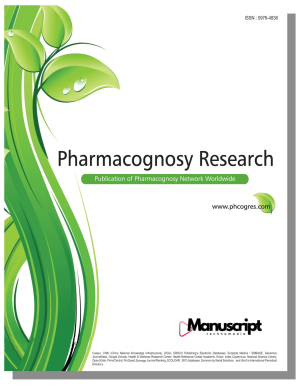
Open a volume to see its issues, then pick an issue for its cover art and complete table of contents. Covers are supplied as vector SVG for reuse in teaching material and seminars.
Keyboard: use Up/Down arrows to move between volumes, Home/End to jump to the first or last, and Enter to open or close a volume.
In this issue
1–20 of 22Review Article
- Review
Ananthapalpu Krishnan Nadar Ramya, Rengasamy Devika
pp. 342–349 · DOI: 10.5530/pres.14.4.51 · 2022
Medicine relies heavily on the use of medicinal plants. In terms of their pharmacology, they showed a broad spectrum of traits. All but a few of the medicinal plants in India are naturally rich in chemicals. An infinite …
- Review
Rishabh Chalotra, Meenakshi Dhanawat, Mubashir Maqbool, Neeru Lamba, Ayesha Bibi, Sumeet Gupta
pp. 350–355 · DOI: 10.5530/pres.14.4.52 · 2022
Iris kashmiriana belonging to the family Iridaceae, is found commonly in graveyards in the Kashmir region of India, as well as in some areas of Pakistan. This plant is used as a traditional medicinal plant by different l…
- Review
Kamal Shah, Sumit Chhabra, Nagendra Singh Chauhan
pp. 356–359 · DOI: 10.5530/pres.14.4.53 · 2022
Honey which is obtained from Apis melliferahas wide uses due to its chemical constituents present in it. World Wide honey is used for nutritious and medicinal purposes. The review would give the platform to the readers, …
Original Article
- Article
Gaurav Tiwari, Deepa Yadav, Bhuwanendra Singh, Abhitendra Kumar, Pranay Wal, Ruchi Tiwari
pp. 360–368 · DOI: 10.5530/pres.14.4.54 · 2022
Background: Diabetic neuropathy (DN) is the most prevalent and problematic consequence of diabetes mellitus, with the highest rates of morbidity and death, as well as a significant financial burden on diabetes treatment.…
- Article
Poonam Shinde, Rajendra Bhambar, Pankaj Patil, Khanderao Jadhav, Prashant Malpure
pp. 369–378 · DOI: 10.5530/pres.14.4.55 · 2022
Background:Ipomoea obscura,also known as “Lakshmanvel” in India, is a member of the Convolvulaceae family. Early studies were mostly concerned with early phytochemical analysis, with only a few focusing on detailed phyto…
- Article
Manish Kumar Gupta, Medha Amol Khade, Birendra Srivastava, Supriya Rajesh Hyam, Prashant Basappa Gurav
pp. 379–390 · DOI: 10.5530/pres.14.4.56 · 2022
Background: Phytopharmaceuticals within the shape of the entire herb, plant parts, or separated bioactive constituents have been utilized broadly in therapeutics since antiquated times till date. The appealing use of dru…
- Article
Safarova Nilufar Mubariz, Isayev Javanshir Isa, Gasimov Eldar Kochari, Rzayev Fuad Huseynali
pp. 391–394 · DOI: 10.5530/pres.14.4.57 · 2022
Background:Representatives of the Campanulaceae family are widespread in Azerbaijan. These plants are rich in biologically active compounds such as flavonoids, essential oils, saponins, coumarins, etc. Objectives:This wo…
- Article
Marília de A Cavalcante, Janyna dos S Oliveira, Mayra S da S Barreto, Lucas P Pinheiro, Patrick de C Cantuária, Wardsson L Borges, Gabriel A da Silva, Tiago Marcolino de Souza
pp. 395–404 · DOI: 10.5530/pres.14.4.58 · 2022
Background:The Amazonian Region has a variety of medicinal plants with bioactive compounds, whose characterization could present the potential for sustainable development. Objectives:A method for separating, identifying,…
- Article
Sarika Ankushrao Nikam, Shilpa Pravin Chaudhari
pp. 405–411 · DOI: 10.5530/pres.14.4.59 · 2022
Background:Plant extracts contain a considerable amount of polyphenols. These polyphenols act as reducing, capping, and stabilizing agents in the formation of silver nanoparticles. Objectives:The objective of the current…
- Article
Sunil Shewale, Vaishali Undale, Maruti Shelar, Bhushan Pimple, Mohini Kuchekar, Vrushali Bhalchim
pp. 412–416 · DOI: 10.5530/pres.14.4.60 · 2022
Aim and Objectives:The exploitation, adulteration and substitution of herbs is major hurdle for development of commercial natural products. Thus, the microscopic evaluation is the first step towards standardization of me…
- Article
Mathias Sylvester Nefai, Mshelia Halilu Emanuel, Giaze Tijani Rabiu, Hussain Yahaya Ungo-Kore
pp. 417–422 · DOI: 10.5530/pres.14.4.61 · 2022
Background:An earlier ethnobotanical study afforded fifteen surveyed plants, which are used as antifungal and wound healing remedies. This informed their antifungal screening to validate folklore claims. Materials and Me…
- Article
Tushar Adhikari, Prerona Saha
pp. 423–428 · DOI: 10.5530/pres.14.4.62 · 2022
Introduction:Leafy vegetables are commonly consumed medicinal plants used in various metabolic and infectious diseases. Additionally, their antiviral, antioxidant, anticancer, and antihypertensive activities have been re…
- Article
Vidhi Bhatia, MS Arohi Paul
pp. 429–441 · DOI: 10.5530/pres.14.4.63 · 2022
Background:Self-emulsifying drug delivery system (SEDDS) and solid-SEDDS of Boswellia serrataextract (BSE) was aimed at overcoming the problems of poor solubility and bioavailability. Materials and Methods:The formulatio…
- Article
Jean Pierre Abdou, Jean Noël Nyemb, Jean Momeni, Atikou Fadimatou, Abel Joël Yaya Gbaweng, Jean Paul Tsopmejio, Guidawa Fawa, Muhammad I. Choudhary
pp. 442–445 · DOI: 10.5530/pres.14.4.64 · 2022
Background:Dalbergia boehmii(Leguminosae),is a medicinal plant used in the Northen part of Cameroon, against digestive tract diseases and fever. Objectives:This work which is part of the search for bioactive molecules th…
- Article
Sheeba Shakeel, Nahida Tabassum
pp. 446–453 · DOI: 10.5530/pres.14.4.65 · 2022
Background:Diabetes mellitus is an increasingly serious health problem in society with type 2 diabetes the most common type of diabetes. Objectives:Our main aim was to test the efficacy of some naturally occurring pure m…
- Article
S Shazamani, Wajeeha Begum, Syeda Sumaiya
pp. 454–460 · DOI: 10.5530/pres.14.4.66 · 2022
Introduction:Cervicitis (Iltehabe unqur rehm)is characterized by inflammation of the cervix. Patients may present with complaints of abnormal vaginal discharge, post coital bleeding, dyspareunia, lower backache and lower…
- Article
Afnan Bahha, Aeshah Habib, Awsaf Alluqmani, Afnan Alqurashi, Ahlam Alotaibi, Yosra Al-Hindi, Arwa Fairaq
pp. 461–467 · DOI: 10.5530/pres.14.4.67 · 2022
Background: Knowledge of potential interaction between herb-drug is essential to reduce both the risk of serious medical disorders such as life-threatening arrhythmia and uncontrolled blood pressure and the increased hea…
- Article
CK Thasneem, GR Vijayasankar, BS Venkateswarlu, R Margret Chandira, S Shanmuganathan
pp. 468–473 · DOI: 10.5530/pres.14.4.68 · 2022
Background:Ethno medicinal validation, together with the screening of phytochemical and biological activity, is an effective method for identifying new drugs from medicinal herbs. Objectives:The present study was aimed t…
- Article
Manvi M, Mohammad Irfan Khan, Badruddeen B, Juber Akhtar, Mohammad Ahmad
pp. 474–482 · DOI: 10.5530/pres.14.4.69 · 2022
Background:Corchorus olitoriusL. (Family: Tiliaceae) or ‘Tossa Jute or Nalta Jute is an important fiber crop in India and Bangladesh. Its leaves are used as folk medicine, food source and have demulcent, diuretic, lactag…
- Article
Ami Thakkar, Nirav Bhatia, Gaurav Doshi
pp. 483–491 · DOI: 10.5530/pres.14.4.70 · 2022
Background:Rheumatoid arthritis (RA) is an autoimmune disorder known for prolonged joint inflammation and deformity condition. Currently, Complementary and alternative medicine (CAM) treatment in RA patients is preferred…