
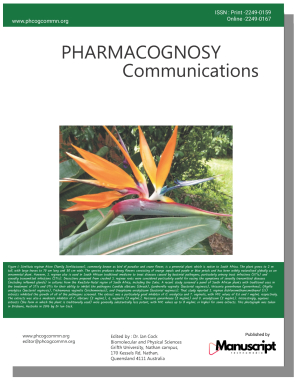
Pharmacognosy Communications
Volume 10, Issue 2
· pp. 62–111 · 8 articles
- Volume
- 10
- Issue
- 2
- Published
- Pages
- 62–111
- Articles
- 8
- Sections
- 2
- ISSN
- Print - 2249-0159 | Online - 2249-0167
- Journal
- PC
In this issue
Original Article
- Article
A Review on Pharmacological Potential of Galantamine
Shagun Dubey Upadhyay, Yusra Ahmad, Seema Kohli
pp. 63–66 · DOI: 10.5530/pc.2020.2.13 · Published
Introduction: Galantamine a traditional herb has also been explored for a number of pharmacological effects. Today, galantamine has been observed for its nootropic effect. Methodology: The objective of this review is to …
- Article
Alphitonia excelsa (Fenzl) Benth. Leaf Extracts Inhibit the Growth of a Panel of Pathogenic Bacteria
Ian Edwin Cock
pp. 67–74 · DOI: 10.5530/pc.2020.2.14 · Published
Introduction: An increase in antibiotic resistance and a corresponding decrease in antimicrobial discovery have directed researchers towards al¬ternative therapies, including plant based medicines. However, synergistic c…
- Article
Tabebuia impetiginosa (Mart. Ex DC. Mattos) Bark Extracts Inhibit the Growth Gastrointestinal Bacterial Pathogens and Potentiate the Activity of some Conventional Antibiotics
Alejandra Fernandez, Ian Edwin Cock
pp. 75–82 · DOI: 10.5530/pc.2020.2.15 · Published
Introduction: Tabebuia impetiginosa (Mart. Ex DC. Mattos) bark has been used to treat inflammation and cancer, as well as a variety of pathogenic diseases, in traditional South American healing systems. As practitioners …
- Article
Protective Effect of Hesperidin on Humoral and Cell-mediated Immunity in Rat Model
Aditya Ganeshpurkar, Ajay Saluja
pp. 83–88 · DOI: 10.5530/pc.2020.2.16 · Published
Context: Hesperidin, an important bioflavonoid, is abundantly found in various foodstuffs and can be regarded as an essential nutraceutical. Hesperidin has been acknowledged for its protective and beneficial effects on v…
- Article
Pouteria australis (R.Br.) Baehni Leaf Extracts Lack Antibacterial Activity and are Non-toxic in vitro
Getmore Chikowe, Lindiwe Mpala, Ian Edwin Cock
pp. 89–94 · DOI: 10.5530/pc.2020.2.17 · Published
Introduction: Closely related plant species often share similar secondary metabolites and bioactivities and are therefore good targets for bioactivity testing when one or more species within a family are known to possess…
- Article
Growth Inhibitory Activity of Acronychia acidula F. Muell. Fruit Extracts Towards Malodour-forming Bacteria
Mitchell Henry Wright, Aiden Wood, Anthony Carlson Greene, Ian Edwin Cock
pp. 95–101 · DOI: 10.5530/pc.2020.2.18 · Published
Introduction: Acronychia acidula F. Muell. (lemon aspen, pigeon berry) has been previously recognized for its antimicrobial properties against a broad panel of pathogenic bacteria. This study assessed the effectiveness o…
- Article
Antimicrobial Activity of Ethanol Extracts and Isolated Fractions Shorea robusta Gaertn f and Dipterocarpus turbinatus Gaertn f
Diptanu Biswas, Bandari Mahalakshmi, B Samelu, M Devadas, Solleti Venkata Suresehkumar
pp. 102–107 · DOI: 10.5530/pc.2020.2.19 · Published
Background: Shorea robusta and Dipterocarpus turbinatus are widely used by the indigenous people of North Eastern state Tripura in their daily life for various purposes. Objectives: The present investigation was aimed to…
The Janus Corner
- Article
Drinking Tea Improves Brain Health and Function
I.E. Cock
pp. 110–110 · DOI: 10.5530/pc.2020.2.21 · Published
A recent publication from a Singaporean-led research team has reported that drinking tea (infusions prepared from Camellia sinensis (L.) Kuntze) leaves helps to protect the brain from age related declines in brain functi…