
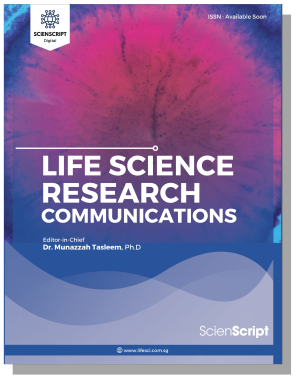
Life Science Research Communications
Volume 2, Issue 1
2026 · pp. 1–74 · 10 articles
- Volume
- 2
- Issue
- 1
- Published
- 2026
- Pages
- 1–74
- Articles
- 10
- Sections
- 3
- ISSN
- Online – 3041-0851
- Journal
- LSRC
In this issue
Review Article
- Review
Overview of Nanotechnology in Drug Delivery Systems
Nisaruddin Ansaruddin, Sanskruti S. Khalokar, Achal D. Agrawal, Sakshi S. Bele, Suraj K. Yadav, Nitin B. Kohale, Harigopal S. Sawarkar
pp. 1–6 · DOI: 10.5530/lsrc.2.1.1 · Published 2026
One area that nanotechnology has benefited the modern medicine is in the field of surgery advancement in the Drug Delivery Systems (DDS). Nanocarriers make targeted, controlled, and effective administration of therapeuti…
- Review
Consumer Trust and Purchase Intention toward AI-Driven Personalized Healthcare and Digital Therapeutics
Pragati Jain, Anurag Verma, Ashish Kumar Gupta
pp. 7–25 · DOI: 10.5530/lsrc.2.1.2 · Published 2026
Artificial Intelligence (AI) is transforming healthcare by enabling personalized support, digital therapeutics, and intelligent health management tools. From diabetes management applications to AI-powered medical chatbot…
- Review
Nanotechnology and Natural Remedies: A Comprehensive Review on Role of Curcumin Nanoparticles in Gout Management
Harsh Mishra, Ridhi Ridhi
pp. 26–39 · DOI: 10.5530/lsrc.2.1.3 · Published 2026
Gout, a chronic inflammatory arthritis driven by hyperuricemia and monosodium urate crystal deposition, remains a significant clinical challenge due to limitations in current pharmacological therapies, including adverse …
- Review
Drug Repositioning as an Innovative Approach in Pharmaceutical Development
Swarnim Swati*
pp. 40–43 · DOI: 10.5530/lsrc.2.1.4 · Published 2026
Drug repurposing, also called drug repositioning, has become a new and effective way to find and develop new drugs. It means finding new ways to use existing or already approved drugs that were made for other diseases. I…
Original Article
- Article
Impact of Pharmacists' Intervention in Treatment Outcome after Cataract Surgery
Aanshi Rikin Patel, Akash P Mathuria
pp. 44–54 · DOI: 10.5530/lsrc.2.1.5 · Published 2026
Background: Medication knowledge and adherence in post-cataract surgery patients is crucial for optimal recovery. Objectives: To compare the effectiveness of verbal counselling, clinic-based pictogram demonstration and t…
- Article
Knowledge, Awareness, and Practices Regarding Vitamin D Deficiency among Postmenopausal Women: A Cross-Sectional Study
Hamid Ismail Hamid Edris, Moghal Habiba Maheen, Mukesh Kumar, Diwakar Kumar Sarraf, Rabin Das
pp. 55–58 · DOI: 10.5530/lsrc.2.1.6 · Published 2026
Background: Vitamin D deficiency is a well-documented yet frequently overlooked public health concern among postmenopausal women, particularly in low- and middle-income countries where diagnostic resources and health lit…
- Article
Pharmacological Evaluation of the Antiulcer Activity of Ricinus communis L. Using In vitro Models
Rahul Nimba Patil, Harshada Milind Jadhav, Ajay Jantar Pawara, Harish Sandesh Khairnar, Snehal Popat Bodke, Anushka Bajirao Rajole
pp. 59–64 · DOI: 10.5530/lsrc.2.1.7 · Published 2026
Background: Peptic ulcer disease is a common gastrointestinal disorder resulting from an imbalance between aggressive factors such as gastric acid and defensive mechanisms of the gastric mucosa. Medicinal plants are wide…
- Article
A Pilot Study on Comparative Evaluation of Pharmaceutical Quality and Plasma Drug Concentration of Branded and Janaushadhi Formulations of Atorvastatin and Losartan Tablets
Sreedevi M, Vishnu Unnikrishnan, Devika Nair, Anaswara Anil, Narmadha M P, Aneesh T P, M K Unnikrishnan, Praveen G Pai
pp. 65–72 · DOI: 10.5530/lsrc.2.1.8 · Published 2026
Background: Affordable access to essential medicines being a major challenge in low- and middle-income countries, India has introduced affordable generics named Janaushadhi. Although branded formulations dominate the mar…
Letter to Editor
- Article
Whole Foods Versus Isolated Compounds: Why Nutrition Trials Keep Asking the Wrong Question
Mueen Ahmed KK*
pp. 73–73 · DOI: 10.5530/lsrc.2.1.9 · Published 2026
Large randomized trials of isolated antioxidant compounds have repeatedly returned null or adverse results, even as whole-food dietary patterns rich in the same compounds remain associated with better health. I write to …
- Article
The Trouble With “Total Antioxidant Capacity” as a Biomarker
Mueen Ahmed KK*
pp. 74–74 · DOI: 10.5530/lsrc.2.1.10 · Published 2026
Total antioxidant capacity (TAC) assays—FRAP, ORAC, TEAC, and their relatives—remain widely used to characterize foods and biological samples, and TAC values frequently appear in nutrition research and on product marketi…